
Why Great Research Deserves Patent Protection Before Publication; Publish or Patent First?
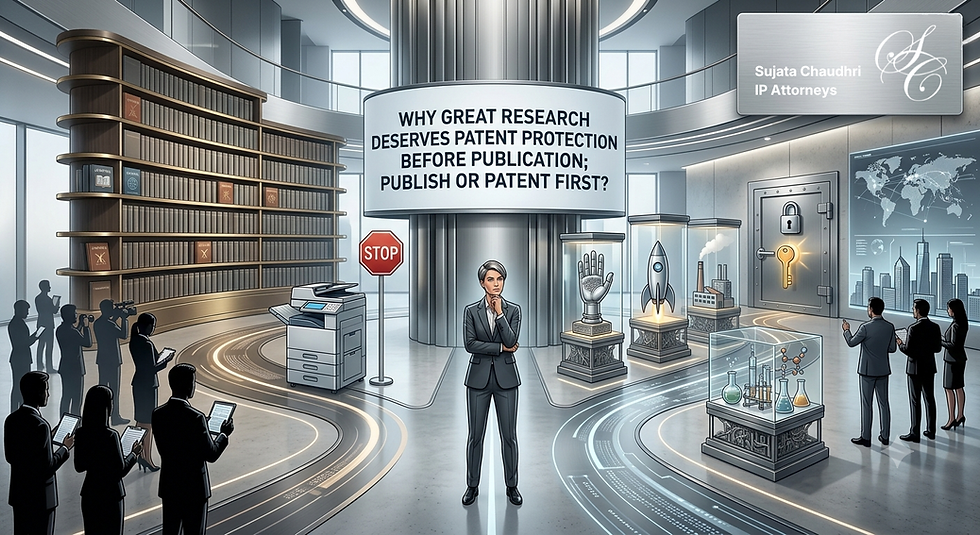
One of the most common questions I hear from researchers, professors, startups, and R&D teams is:
"Should we publish our research first or file a patent first?"
As, a Patent attorney my answer can determine whether your innovation becomes a valuable intellectual asset or enters the public domain forever.
A few weeks ago, I was discussing an innovation with a researcher who had spent nearly three years solving a complex technical problem. The research was novel, the experimental results were promising, and the manuscript had already been accepted by a reputed journal.
The excitement was understandable. But then came a question that changed the entire conversation:
"We have already submitted the paper. Can we file a patent now?"
Unfortunately, this is a situation that patent professionals encounter far more often than they should.
Researcher spending years conducting research, investing significant resources, publishing your findings, receiving appreciation from the scientific community, and only later discovering that the publication itself may have become the biggest obstacle to obtaining patent protection in many jurisdictions.
The irony is that researchers often believe publication establishes ownership. It certainly establishes authorship and contributes to scientific knowledge. However, patents are governed by a different principle. A patent is granted not because you were the first to publish, but because, at the time of filing, your invention satisfies the legal requirements, including novelty. Once an invention enters the public domain through a journal article, conference presentation, thesis, exhibition, product demonstration, or even an online disclosure, it may become prior art against your own patent application.
This is where many valuable innovations lose their commercial potential; not because the technology lacked merit, but because the timing of protection was overlooked.
Now, I am here and consulting you to consider a different approach.
Another research team working on an equally promising technology paused for a brief discussion with their IP team before submitting their manuscript. A patent application was prepared and filed first. Only after securing the filing date did, they proceed with publication.
The outcome was remarkably different.
The researchers still published their work, received citations, and presented it at international conferences. At the same time, the institution retained the opportunity to commercialize the technology, negotiate licensing arrangements, collaborate with industry, and build a valuable patent portfolio around the invention. The science reached the world and parallelly the intellectual property remained protected.
This is why I often say that patents and publications are not competitors; they are partners. One advances human knowledge, while the other protects the commercial value of that knowledge. When managed strategically, both objectives can be achieved without compromising either.
Before publishing any research, it is worth asking one simple question:
If this innovation has the potential to become a product, attract investment, generate licensing opportunities, or create a competitive advantage, should it first be protected?
In most cases, the answer is yes.
The difference between an invention that is merely admired and one that creates long-term impact often comes down to a single decision made before clicking "Submit" on a journal portal.
Protect the innovation first.
Then share it with the world.
You may consult with us for brief discussion at shabana@sc-ip.in
What Next: Before you publish or present your innovation, Here's what every Researcher


Comments